You need to upgrade your Flash Player The theme of this blog is not only and obviously space, but in particular “terrestrial worlds”, places that tend to have surfaces on which one could walk or at least attach oneself to. These places sometimes also have other earth-like familiar features such as atmospheres, weather, volcanos, geysers and perhaps, we are finding, even exotic oceans, rivers or lakes that are not necessarily made of familiar materials we are used to here at home. The second theme is imagery. Occasionally I do some retouching of images when needed if an image is incomplete or sometimes “dirty” or noisy. I will attempt to correct image shortcomings based upon other images or well-accepted presumed attributes. When this is done, notes will be offered as to what was added, why and sometimes how it was done. This way no one should ever wonder if something they are looking at is real or photoshop.

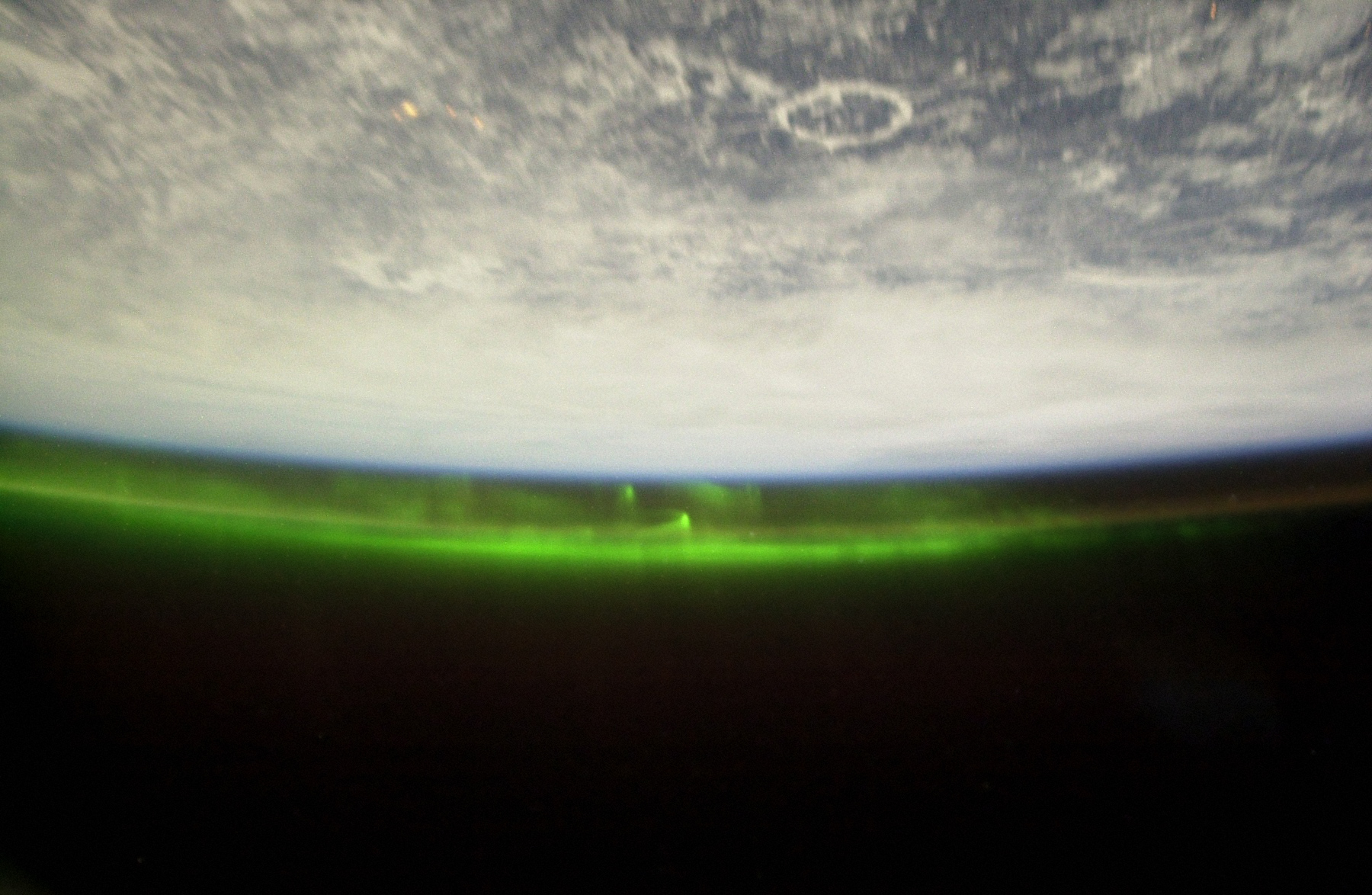
Earth Aurora and Crater from ISS

Earth Aurora from ISS

Above is an aurora as seen from The International Space Station. The large white circular feature seen at the top is the Manicouagan impact crater located in northern Canada.

NOTE: Some image alteration has been applied to remove a large amount of noise and discoloring largely from the area of black space below the Earth.

6 Responses to “Earth Aurora and Crater from ISS”

  1. Anita Says:

    Wow, that’s pretty impressive. The most unfamiliar angle I’ve seen of Earth in a while…..

  2. Bill Says:

    I’m assuming you saw this:

    http://www.guardian.co.uk/science/2007/dec/29/spaceexploration.northernlights

  3. thomas Says:

    interesting that nobody ever even sent a camera up through one.

  4. Gordan Says:

    Sending a camera through the aurora wouldn’t be very spectacular I imagine. Sort of like riding through the fog or a comet’s tail - impressive from a distance but that’s it. There’s not much local variation in the aurora to get a better view from up close.

  5. thomas Says:

    probably not for a camera, but for human eyes… i’ll bet you would see something different. Often the camera cannot capture what the full field view of human eyes can or detect the changing nuances of vision.

  6. Adan Guttierez Says:

    Want to see the coolest Outer Space pictures ? Galaxies Pictures , Constalation Pictures, and Deep Space Pictures.

Leave a Reply